
If you observe winged ants in your house, you have what is known as “alates” or “swarmers”. These are part of a colony of ants. Their specialization is reproduction. They take flight in order to create new ant colonies. Now, if you see winged creatures that you believe to be ants, you should verify what they are, as winged ants resemble winged termites. In this guide, we will be providing you with a wealth of information – including how to tell exactly what that creature is that looks like an ant with wings.
Are the Winged Insects in My Home Ants or Termites?
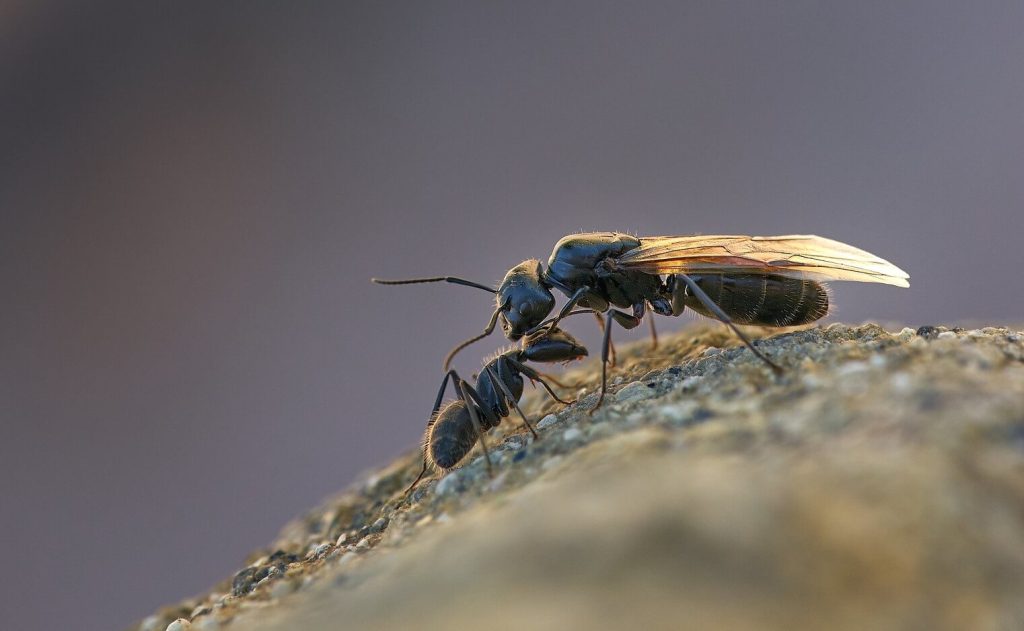
Winged ants are known to resemble termites. To tell them apart, look at the antennae. Ants have elbowed or bent antennae, and termites have straight antennae. Ants have a narrow, pinched waist, and termites have a relatively broad waist. The wings on an ant are unequal in length. The wings on a termite are of equal size in length. If you find that you are actually dealing with winged ants, their presence likely indicates that a nest is located nearby. In most instances, the infestation will be a carpenter ant infestation.
How to Identify Carpenter Ants
If you are attempting to identify the winged ants in your house to determine if they are carpenter ants, look at the waist. It will be pinched. The antennae will be elbowed. The front wings will be significantly longer than the back wings. If you confirm that the winged ants are carpenter ants, you should know that the swarmers will only be present for a short period of time; however, their presence indicates that there is a large colony in your home that needs to be targeted by professional pest control.
Why are Winged Ants Inside My Home?
Flying ants are known to make themselves known in large numbers. You will usually see them on hot days that have high levels of humidity, and often after a summer rain has fallen. This is when they engage in a “nuptial flight”, which is a ritual where they go to mate and create new colonies.
Does Having Winged Ants in Your House Mean You Have Termites, Too?
The good news is that having winged ants in the home does not mean that you have termites. Ants with wings are “swarmers” (reproductive ants) that are attempting to create a new colony. They are often mistaken for termites due to the wings and the body’s appearance. Both winged ants and winged termites indicate that a colony is nearby, but each is a distinct species with different implications for the home. Despite not being a sign for termites, most winged ants are carpenter ants that have the potential to do damage to the home.
What Are the Signs That Winged Insects Are Actually Termites?
What you believe to be winged ants may actually turn out to be termites. The following outlines distinct features and/or signs that could mean that the flying insects you are seeing in your home are actually termites:
- The first sign that you are seeing termites are wings that are discarded. The wings will be equal in size and are typically seen on windowsills and/or in spider webs.
- Wood that is damaged is a sign of termites. In most cases, the wood sounds hollow, looks as if it is blistered, and has bubbled-up paint on it.
- If what you are seeing is subterranean termites, you will likely see mud tunnels on the foundation of the home, and/or on the walls of the home.
What is the Fastest Way to Get Rid of Winged Ants in the House?
There are several ways to get rid of winged ants in the house. The first and main course of action involves using potentially harmful chemicals that will leave behind unhealthy residue. The easiest and safest way is to use a vacuum and dump out the vacuum canister outside, far away from the home. Finally, contact a professional pest control company.
How Do I Figure Out Where Winged Ants Are Coming From?
If you see winged ants in the house, it indicates that there is an ant nest nearby. To find the nest, you should understand that they will usually be found near a source of moisture, a foundation, or wood. Look around your lawn, on your patio, and on the sidewalks near your home. You should look to see if you see piles of dirt. You may check indoors, too. Look near the window frames of your home, the baseboards, and similar locations. If you see any worker ants, follow them as they trail off. Look for wood that is damaged by water and is cracked. All of these areas may have an ant nest.
What Repels Flying Ants?
There are many products that repel flying ants. These include insecticidal sprays, borax, insecticidal dust, peppermint, orange, cloves, cinnamon, lemon, lavender, citronella, and cedar wood. By using these items in and around the interior of your home, you will find that flying ants go away on their own.
Where Do Winged Ants Lay Eggs?
The queen ant will locate a site that is suitable and then will dig herself an underground chamber. Once she enters the chamber, she will lay some eggs. She will rear these newborns into adulthood. She will not eat until the first brood of daughter worker ants are ready to forge food for her.
Why Should You Not Squish Ants in the House?
When you squish an ant in the home, it immediately releases alarm pheromones that send out a distress signals to other colony members. It does not scare those members away. Instead, it acts as a chemical-based message that actually attracts more ants into that vicinity. This could make a bad ant problem an even worse ant problem.
How to Get Rid of Winged Ants Permanently
If you have had winged ants in your home and you want to get rid of them permanently, you should start by sealing any potential entry points near the doors, windows, and/or cracks in the walls. Be certain to clean up any and all food sources, and wipe up any moisture to eliminate it. If you have any type of rotting wood inside or outside of your home, you should get rid of it and/or replace it so that ants are discouraged from nesting in, on, or near it.
What Months Do Flying Ants Come Out?
Winged ants are known to come out mostly in July and August; however, it is possible for them to appear as early as June and as late as September. These types of swarms tend to be triggered by weather that is hot and has a high level of humidity. Rain typically draws out the winged ants. The swarm could last just a few days or up to a couple of weeks or longer.
Signs There is an Ant Colony in the House
There are many distinct signs that there is an ant colony somewhere in your home. These include rustling-like sounds, small piles of wood or dirt shavings, tiny gaps where there are ants entering and exiting. You may also see trails of ants going in and out of one location. If you see any of these signs, it is advised that you have an inspection performed by a professional pest control company.
How Many Ants Live in a Nest?
An ant nest could have a few hundred ants to several million – it all depends on how big the colony is. The average one usually has between 19,000 and 100,000 worker ants. The population will depend on the ant species, how old the colony is, and the environmental conditions near the nest. There have been some fire ant nests that have had up to 20 million ants.
Will Winged Ants Go Away on Their Own?
Yes, winged ants are considered to be a temporary nuisance and will go away on their own within a few days and up to a couple of weeks. They make their appearance when it is mating season. Once the males die, the females will then shed their wings and move on to start new colonies in other locations. Full warms are known to only last a few hours.
Should I Worry about Winged Ants in My House?
Yes, you should worry about winged ants in your house. Mainly because they often serve as a sign that there is a hidden and strongly established nest somewhere in your home. In most instances, these locations include the walls, the ceilings, and the basement areas of the home. They do not eat wood like termites do, but they have the potential to damage structures. This is especially true of carpenter ants, so, it is important to have immediate and specifically targeted professional pest control to stop the colony from developing any further and to kill out the colony that is present. If you would like to learn more or set up an inspection, contact us here at All Pest today by calling: 765-965-2171
